
Evangelicals & Watching the Times: Supreme Court Girls' Sports Decision: Why Evangelicals Must Watch the Times
Updated: Sep 9
The Supreme Court, Girls' Sports, and Why This Decision Matters
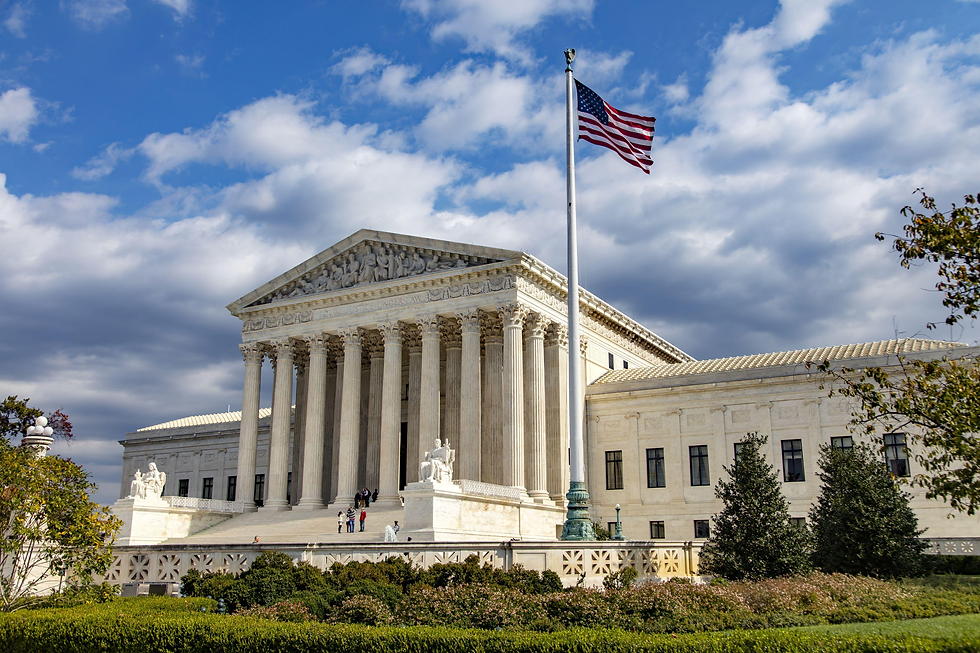
The recent decision by the United States Supreme Court affirming that states possess the constitutional authority to restrict participation in girls' athletic competition to biological females will undoubtedly be remembered as one of the most significant cultural rulings of the past several years. While many commentators have focused almost exclusively on the debate surrounding transgender participation in athletics, the decision reaches far beyond locker rooms, playing fields, and championship trophies. At its core, the case reaffirmed a constitutional principle that has increasingly been neglected throughout modern American jurisprudence: judges are commissioned to interpret the law, not create new law from the bench.
That distinction is neither insignificant nor merely academic. It is one of the foundational pillars upon which the American constitutional system rests. The Framers intentionally separated governmental authority among three coequal branches. Congress writes laws. The Executive enforces laws. The Judiciary interprets laws. When each branch remains within its constitutionally prescribed role, liberty is protected. When one branch begins exercising powers reserved to another, constitutional government begins to erode.
For decades, many Americans have witnessed an increasingly activist judiciary that has often ventured beyond interpreting statutory and constitutional language into effectively establishing national policy. Regardless of one's political persuasion, this trend should concern every citizen who values limited government. Courts were never intended to function as super-legislatures empowered to resolve every controversial social question according to contemporary cultural preferences. Their responsibility is far more restrained—and far more important. They exist to determine what the law says, not what individual judges believe it ought to say.
The Supreme Court's recent ruling represents a meaningful reaffirmation of judicial restraint. It reminds both elected officials and the American public that policy decisions of this nature ordinarily belong to legislatures accountable to the people rather than unelected judges serving life appointments. One need not agree with every legislative policy enacted by a particular state to appreciate the constitutional principle being defended. Representative government depends upon representatives making laws and judges faithfully applying them.
Judicial Activism Has Become Increasingly Common

The division within the Court once again illustrated two fundamentally different approaches to constitutional interpretation. The majority approached the Constitution as a fixed governing document whose meaning is derived from its text, history, and original public understanding. The dissenting justices embraced a broader interpretive philosophy that views constitutional protections as evolving to address modern circumstances in ways the Framers could not have anticipated.
This distinction extends well beyond the present controversy. It has become one of the defining legal debates of our generation.
Judicial restraint recognizes that constitutional amendments and legislative action—not judicial innovation—remain the proper avenues for changing public policy. Judicial activism, by contrast, often produces outcomes that effectively rewrite existing law while bypassing the legislative process entirely. Whether addressing abortion, religious liberty, administrative authority, or questions involving gender and sexuality, Americans increasingly find themselves governed not by legislation enacted through elected representatives but by judicial opinions that establish new constitutional doctrines.
From a biblical perspective, this development raises an even deeper concern. Scripture consistently teaches that God is a God of order rather than confusion. Authority carries divinely established boundaries. Parents possess responsibilities distinct from children. Elders possess responsibilities distinct from congregations. Civil magistrates possess responsibilities distinct from the Church. Likewise, each branch of civil government possesses responsibilities distinct from the others. Whenever God-ordained boundaries become blurred, confusion inevitably follows.
The issue, therefore, is not merely whether biological males should compete against biological females. The broader issue concerns whether constitutional limits continue to matter. Once society becomes comfortable allowing one governmental institution to exceed its lawful authority because we approve of the immediate result, we should not be surprised when that same precedent is later used to advance policies we strongly oppose.
History repeatedly demonstrates that constitutional erosion rarely occurs all at once. More often it advances gradually, one seemingly reasonable exception at a time. I commonly refer to what Rudi Dutschke called the Long March through the Institutions.
The cultural revolution unfolding before our eyes did not happen accidentally or overnight. Borrowing imagery from Mao Zedong's Long March, Dutschke argued that rather than seeking immediate political revolution, the Left should gradually transform society by influencing its major institutions—education, the media, the courts, government, entertainment, and other centers of cultural authority.
Decades later, many observers believe this strategy has borne significant fruit, as institutions that once largely reflected Judeo-Christian values now frequently promote ideas fundamentally at odds with a biblical worldview. Whether one agrees with every aspect of Dutschke's vision or not, the remarkable cultural transformation that has occurred over the past half-century should prompt thoughtful Evangelicals to ask how such sweeping changes became possible. While many believers remained disengaged from the cultural conversation, others worked patiently and intentionally to shape the institutions that now influence nearly every aspect of American life.
Constitutional Confusion Reflects a Deeper Spiritual Problem
While constitutional government deserves vigorous defense, America's deepest crisis is not political. It is spiritual, and let us, as Evangelicals, never forget this truth.
Political institutions merely reflect the moral and spiritual condition of the people they govern. Legislatures, courts, universities, corporations, and media organizations do not exist independently of society; they are populated by individuals whose worldview has been shaped by competing visions of truth. Consequently, whenever a nation abandons God's authority, that rebellion eventually manifests itself within every cultural institution.
The controversy surrounding girls' sports illustrates this reality with remarkable clarity. Only a generation ago, the proposition that biological sex could be separated from objective biological reality would have been dismissed by virtually every serious scientist, physician, educator, and policymaker. Today, individuals who simply affirm that men and women are biologically distinct often find themselves accused of intolerance. Such dramatic cultural transformation did not occur overnight. It resulted from decades of philosophical, educational, political, and spiritual decline.
As believers, we should certainly celebrate whenever truth prevails in the public square. Nevertheless, we must also recognize that lasting cultural renewal cannot be achieved merely through favorable judicial decisions. Courts may restrain certain manifestations of moral confusion, but only the transforming power of the Gospel can change the human heart. Political victories are temporary. Spiritual transformation is eternal.
That reality should remind Evangelicals that our ultimate hope has never rested in political parties, presidents, or Supreme Court justices. Our confidence rests exclusively in the sovereign reign of Jesus Christ, period, full-stop, and end of story.
Looking Beyond the Headlines
While the Supreme Court's decision regarding girls' sports deserves careful attention, it would be a mistake to view it in isolation. One of the greatest weaknesses within modern American evangelicalism is our tendency to examine events independently rather than collectively. We become consumed with one news cycle, only to move immediately to the next without considering how these developments fit within the broader moral and spiritual trajectory of our nation and the world.
The Scriptures repeatedly encourage believers to understand the times in which they live. The men of Issachar were commended because they "had understanding of the times, to know what Israel ought to do" (1 Chronicles 12:32). Their wisdom was not rooted in political strategy or military strength but in discernment. They recognized that understanding the age in which they lived was essential to faithfully serving God within it.
That same discernment is desperately needed today.

As I write this article, the war in Ukraine continues with no lasting resolution in sight. What began as a regional conflict has developed into one of the defining geopolitical crises of the twenty-first century, affecting global security, energy markets, international alliances, and the stability of Europe itself. Thousands have lost their lives, millions have been displaced, and the possibility of further escalation remains a constant concern.
Nor is Ukraine the only region demanding our attention. The Middle East remains one of the most volatile areas on earth. Israel continues to confront threats from multiple fronts while regional powers maneuver for influence. Terrorism, proxy wars, religious hostility, and political instability have produced a landscape where peace remains elusive despite repeated diplomatic efforts.
For students of Scripture, the Middle East occupies a unique place in redemptive history. This is the land where God established His covenant with Abraham, where Jesus Christ ministered, died, rose again, and from which He will one day return. While not every conflict should be viewed as a direct fulfillment of biblical prophecy, neither should believers ignore a region that occupies such a central place in God's unfolding plan of redemption.

At the same time, the world continues to experience an increasing frequency of natural disasters. Recent earthquakes in Venezuela have once again demonstrated how quickly life can be altered by forces entirely beyond human control. Entire communities have been shaken, families displaced, and lives forever changed in a matter of moments.
Earthquakes have always occurred throughout history, and it would be irresponsible to suggest that every tremor represents a direct prophetic fulfillment. Yet Jesus Christ specifically included earthquakes among the signs that would characterize the present age before His return. They serve as reminders that creation itself groans under the effects of sin and eagerly awaits its ultimate redemption.

Watching Without Speculating
Whenever discussions turn to biblical prophecy, two unhealthy extremes frequently emerge. On one side are those who attempt to assign dates to Christ's return, identifying every major news event as definitive proof that the end has arrived. History has repeatedly demonstrated the folly of such speculation, and Scripture explicitly warns against it.
On the opposite side are those who virtually ignore prophecy altogether. They dismiss any discussion of current events as sensationalism and live as though Christ's return is a distant theological abstraction with little relevance to everyday life.
Neither approach reflects the teaching of Scripture.
Jesus Christ repeatedly instructed His followers to remain spiritually alert. In Luke 21:36 He declared, "Watch therefore, and pray always." Likewise, in Matthew 24 and Matthew 25 He repeatedly emphasized readiness, vigilance, and faithful service while awaiting His return. The emphasis is not upon predicting the calendar but upon cultivating spiritual preparedness.
The Apostle Paul echoed this same truth when he reminded believers, "And do this, understanding the present time: The hour has already come for you to wake up from your slumber, because our salvation is nearer now than when we first believed" (Romans 13:11).
That verse deserves careful reflection.
Paul was not writing to unbelievers. He was addressing Christians who had grown spiritually complacent. His concern was not that they lacked information but that they lacked urgency. They knew Christ was coming again. What they had lost was the sense that His return should shape how they lived each day.
I fear the same spiritual lethargy has settled over much of the Evangelical Church in America and most especially in the Negro professing Church.
Many professing believers display remarkable enthusiasm for sports, politics, financial markets, and entertainment, yet show comparatively little interest in understanding God's Word or discerning the significance of the times in which they live. They can discuss every major cultural controversy yet rarely meditate upon Christ's repeated command to watch, pray, and remain faithful. I readily acknowledge I pursue these pursuits, so I am not advocating an either/or framework but instead a both/and. As Evangelicals, we should be able to walk and chew at the same time. I am not advocating that Christ-followers hunker down and impassively wait for the return of Jesus Christ. What I am advancing is that we do both: we engage in whatever pursuits bring us legitimate joy AND keep our eyes upon eternity, using the gifts and talents God has graciously given us.
One thing we can never do is display callous, selfish indifference. This indifference should concern us.
While I do not claim to know when Jesus Christ will return, I do believe it is entirely possible that we are witnessing developments that point us toward the culmination of God's redemptive plan. The convergence of moral decline, global instability, increasing hostility toward biblical truth, attacks upon the created order, and widespread spiritual apathy should compel every believer to examine his own heart and renew his commitment to faithful obedience.
The question is not whether Christ could return in our lifetime. The question is whether we are living as though we genuinely believe He could.
The Greatest Crisis Is Not in Washington but in the Church

If America's greatest problem were merely political, the solution would be relatively straightforward. Elect different leaders. Appoint different judges. Pass different legislation. While those actions certainly have their place within our constitutional republic, they cannot address the fundamental issue confronting our nation. America's deepest crisis is spiritual.
Throughout Scripture, whenever God's people abandoned His truth, national decline inevitably followed. Political corruption, moral confusion, economic instability, and social unrest were never presented as isolated problems. They were symptoms of a people who had first departed from the Lord. The prophets repeatedly called Israel and Judah to repentance because they understood that national renewal always begins with spiritual renewal.
The same principle remains true today.
Far too many professing Evangelicals have become spectators rather than watchmen. Instead of evaluating our culture through the unchanging authority of Scripture, many have adopted the priorities, assumptions, and value systems of the surrounding culture. Some have become so politically tribal that they excuse sin when committed by those with whom they agree politically while condemning identical behavior in their opponents. Others have withdrawn almost entirely from cultural engagement, convincing themselves that, because this world is not our home, we bear little responsibility to confront error or defend truth.
Neither response reflects biblical Christianity.
Jesus Christ called His followers to be "the salt of the earth" and "the light of the world." Salt that loses its distinctiveness has little value. Light hidden beneath a basket cannot illuminate the darkness. The Church was never intended to mirror the culture but to influence it by faithfully proclaiming God's truth.
Biblical Discernment Must Rise Above Political Admiration
One area where this lack of discernment has become particularly evident is within segments of the Negro Evangelical community. Rather than evaluating public officials according to biblical principles, many continue to demonstrate unwavering admiration for political figures whose policies frequently stand in direct opposition to clear biblical teaching.

Former President Barack Obama illustrates this concern. His election represented a historic moment in American history, and there is no denying the significance of his becoming the nation's first African American president. However, historic significance should never exempt any public official from biblical evaluation.
Throughout his presidency, President Obama consistently supported policies concerning abortion, marriage, sexuality, and religious liberty that many Evangelicals have long understood to conflict with the plain teaching of Scripture. Yet despite these positions, many professing Evangelicals, especially Negro professing Evangelicals, continue to celebrate his legacy with little apparent concern for those profound theological differences.
The enthusiasm surrounding the Obama Presidential Center serves as another reminder of how easily personality, race, nostalgia, and political identity can overshadow biblical discernment. I do not raise this example to diminish the accomplishments of any individual or to deny the historical significance of his presidency. Rather, I raise it because it illustrates a larger problem. Believers must never allow admiration for any political leader—whether Democrat, Republican, Independent, or otherwise—to replace their primary allegiance to Jesus Christ.
Scripture commands us to test everything. That command applies equally to presidents, pastors, political parties, media personalities, and even ourselves. Our loyalty belongs to Christ before it belongs to any movement, ideology, ethnicity, or nation.
The Biblical Responsibility of the Watchman

The image of the Watchman did not originate with modern commentators or political observers. It originated with God Himself. In the book of Ezekiel, the Lord appointed the prophet to serve as a Watchman over the house of Israel. A Watchman stood upon the city walls, carefully scanning the horizon for approaching danger. If he saw the enemy coming, he was obligated to sound the trumpet and warn the people. Their response was their responsibility; the warning was his.
God told Ezekiel: "Son of man, I have made thee a watchman unto the house of Israel; therefore hear the word at my mouth, and give them warning from me." (Ezekiel 33:7)
The Apostle Paul reinforces this responsibility in Ephesians 5:11, where he commands believers, "And have no fellowship with the unfruitful works of darkness, but rather reprove them." The Christian's responsibility is therefore both positive and negative. Positively, we proclaim the glorious Gospel of Jesus Christ and the hope found in Him alone. Negatively, we expose deception, identify error, and refuse to remain silent while God's created order and His revealed truth are being rejected.
Why I Continue to Write and Speak
People occasionally ask why I devote so much time to producing videos, writing blogs, publishing books, and addressing controversial cultural issues. My answer is rooted in the biblical doctrine of the watchman. I believe that, like Ezekiel, every generation of God's people has a responsibility to warn, instruct, encourage, and call others back to faithful obedience to God's Word. While Ezekiel occupied a unique prophetic office, the responsibility to proclaim truth and expose the works of darkness belongs to every follower of Jesus Christ.
I believe God has called believers to serve as Watchmen.
Throughout the Old Testament, Watchmen occupied the walls of cities, scanning the horizon for approaching danger. Their responsibility was not to determine whether people appreciated the warning. Their responsibility was simply to recognize the danger and faithfully sound the alarm. If the people listened, lives could be saved. If they ignored the warning, the watchman had nevertheless fulfilled his duty.
This biblical mandate explains why cultural engagement is not optional for mature believers. We are not called to be quarrelsome, arrogant, or unnecessarily combative. Neither are we called to retreat into comfortable silence while our families, churches, and nation drift further from biblical truth. Like Ezekiel, we have been entrusted with a message that is not our own.
Our responsibility is not to determine whether that message will be popular, but to faithfully proclaim it. That imagery has profoundly shaped my own understanding of ministry.
When I examine our culture, I see increasing hostility toward biblical authority, confusion regarding the family, attacks upon the sanctity of life, the rejection of God's created order, growing judicial activism, declining biblical literacy, and widespread spiritual complacency within churches that once boldly proclaimed God's truth. I also see a world increasingly characterized by wars, geopolitical instability, natural disasters, and moral confusion. While none of these developments allows us to predict the day of Christ's return, together they should compel every believer to heed Christ's repeated command to watch and pray.
For that reason, I continue writing.
For that reason, I continue producing videos.
For that reason, I continue speaking.
My purpose is not to provoke controversy merely to gain attention. Nor is it to encourage fear or despair. My desire is to point people back to the authority of God's Word and to encourage believers to think biblically about the issues confronting our generation. If these articles, videos, or books help even one person develop greater discernment, deepen his commitment to Christ, or boldly proclaim the Gospel, then every hour invested has been worthwhile.
The One Thing We Cannot Do Is Nothing
For many years, a statement commonly attributed to Edmund Burke has circulated: "The only thing necessary for the triumph of evil is for good men to do nothing." Historians have demonstrated that Burke almost certainly never made that exact statement. Nevertheless, the principle expressed by the quotation remains profoundly true.
Evil advances when righteous people become silent.
That reality should challenge every Evangelical reading these words.
Not everyone has been called to write books. Not everyone has been called to host a YouTube channel, publish a blog, preach from a pulpit, teach a Sunday School class, or speak before large audiences. God gifts His people differently and places them in different spheres of influence according to His sovereign purpose.
Yet every believer has been given a voice.
Some will influence children and grandchildren. Others will encourage fellow church members. Some will faithfully witness in the workplace, while others will minister through hospitality, personal discipleship, writing, public service, or quiet acts of faithfulness that only
God fully sees. The size of the platform is not what matters. Faithfulness is.
As the Lord leads, make your voice heard.
Speak the truth in love.
Defend those who cannot defend themselves.
Proclaim the Gospel of Jesus Christ without compromise.
Encourage the discouraged.
Correct error with humility.
Strengthen your local church.
Disciple your family.
Pray for your nation.
Above all, remain faithful to Christ.
The one thing believers cannot justify is doing nothing.
As our world continues to change before our eyes, may we refuse the temptation toward apathy that has gripped so much of the modern Church. Instead, may we heed our Lord's command to watch and pray, remembering that every passing day brings us one day closer to seeing our Savior face to face.
Until that glorious day arrives, my prayer is that these videos, blogs, and books will continue to serve as a trumpet blast, calling God's people to awaken from spiritual complacency and return to the authority of His Word. If the Lord is pleased to use this ministry to encourage even a remnant to stand courageously for biblical truth, then every effort will have been worthwhile.
May we never be found sleeping when Christ has commanded us to watch.
May we never be found silent when truth demands a voice.
And may we never forget that while we cannot control the course of history, we can determine whether we will be faithful in the generation to which God has called us.
"And what I say unto you I say unto all, Watch." — Mark 13:37 (KJV)
With profound fear & trembling.
Ricky V. Kyles Sr., DEd.Min.
Thinking Critically from an Evangelical Worldview


Comments